


One of the most common questions people ask when planning for retirement is whether they should contribute to a Roth IRA or a Traditional IRA. Both accounts offer valuable tax advantages and can help build long-term retirement savings. However, the biggest difference comes down to when you pay taxes on your money: today or in the future.
Understanding how each account works can help you make a more informed decision about which strategy may be appropriate for your financial situation.
What Is a Traditional IRA?
A Traditional Individual Retirement Account (IRA) allows you to contribute money toward retirement and potentially receive a tax deduction for your contribution.
Depending on your income and whether you or your spouse participate in an employer-sponsored retirement plan, your contributions may be fully deductible, partially deductible, or nondeductible.
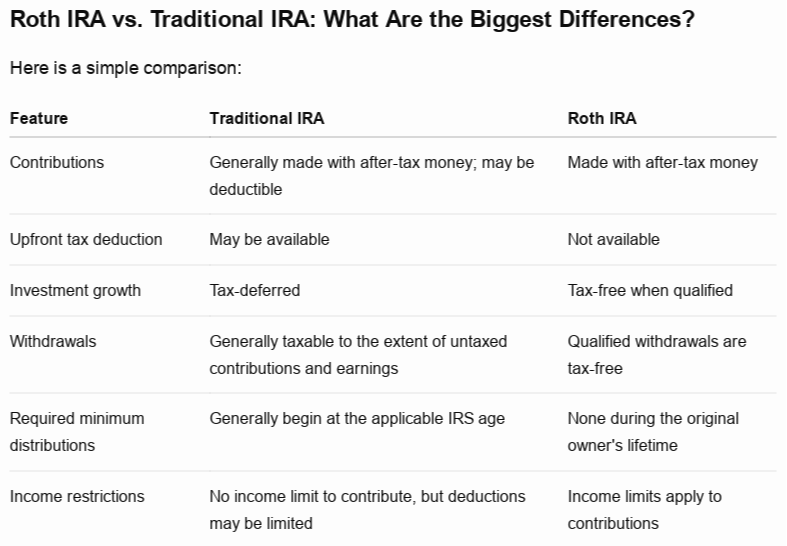
The primary advantage of a Traditional IRA is the potential for an immediate tax benefit. When contributions are deductible, they can reduce your taxable income in the year you make them. Investments inside the account grow tax-deferred, meaning you generally don't pay taxes on investment earnings until you withdraw the money.
The trade-off comes later. Withdrawals of deductible contributions and their earnings are generally taxed as ordinary income. Traditional IRA owners must also begin taking required minimum distributions (RMDs) when they reach the applicable age under IRS rules, whether or not they need the money.
For someone who expects to be in a lower tax bracket during retirement than during their working years, the upfront tax deduction may be attractive.
What Is a Roth IRA?
A Roth IRA takes a different approach. Contributions are made with money that has already been taxed, meaning you don't receive an upfront tax deduction.
The benefit comes later.
Qualified withdrawals from a Roth IRA are completely tax-free, including investment earnings. To qualify, the account generally must satisfy the five-year holding requirement, and the distribution must occur after age 59½ or meet another qualifying exception.
Another important advantage is that Roth IRA owners are not required to take minimum distributions during their lifetime. This gives investors more flexibility in deciding when to use their retirement savings.
For individuals who expect to be in the same or a higher tax bracket in retirement, paying taxes today in exchange for potentially tax-free withdrawals later may be an attractive strategy.
Both accounts have annual contribution limits. For 2026, individuals can contribute up to $7,500 per year, or $8,600 for those age 50 or older, assuming they have sufficient eligible compensation. This is a combined limit across Traditional and Roth IRAs, not a separate limit for each account.
Which IRA Is Better for You?
There isn't one answer that works for everyone. The right choice often depends on your current income, expected future tax bracket, age, retirement timeline, and overall financial plan.
A Traditional IRA may make sense if:
- You are currently in a relatively high tax bracket.
- You expect your income and tax bracket to be lower in retirement.
- You would benefit from an immediate tax deduction.
- You prefer to defer taxes until you begin withdrawing retirement funds.
A Roth IRA may make sense if:
- You are currently in a lower tax bracket than you expect to be in retirement.
- You have many years for tax-free investment growth.
- You want more flexibility over when you withdraw retirement money.
- You want to avoid lifetime required minimum distributions from the account.
For younger investors, a Roth IRA can be particularly appealing because they may have decades for their investments to grow. For individuals closer to retirement, the decision may be more complicated and should take their current tax situation and anticipated retirement income into consideration.
Can You Have Both a Roth IRA and a Traditional IRA?
Yes. You can own both types of accounts and contribute to both in the same year, provided you meet the applicable requirements.
However, the annual contribution limit applies to the combined contributions across both accounts.
For example, an individual under age 50 could contribute $4,000 to a Traditional IRA and $3,500 to a Roth IRA in 2026, for a combined contribution of $7,500, assuming sufficient eligible compensation and Roth IRA income eligibility.
It's also important to understand that participating in an employer-sponsored 401(k) does not prevent you from contributing to an IRA. However, workplace retirement plan participation can affect whether Traditional IRA contributions are deductible, and income limits still apply to Roth IRA contributions.
Don't Overlook the Roth Conversion Strategy
There is another strategy worth discussing: converting money from a Traditional IRA to a Roth IRA.
A Roth conversion involves moving money from a tax-deferred retirement account into a Roth IRA. The converted amount is generally included in taxable income for the year of conversion, but future qualified withdrawals can be tax-free.
For some investors, converting portions of a Traditional IRA over several years may help manage their future tax exposure. This can be particularly worth evaluating during years when income is temporarily lower, such as after retirement but before Social Security or required minimum distributions begin.
However, conversions can increase taxable income, affect Medicare premiums, and create other tax consequences. They should be evaluated carefully before proceeding.
The Bottom Line: It's About More Than Choosing an IRA
Choosing between a Roth IRA and a Traditional IRA isn't simply a question of which account has better tax benefits. It's about understanding how each option fits into your broader retirement strategy.
Your current tax bracket, anticipated retirement income, investment timeline, withdrawal needs, and estate-planning goals should all be considered.
Remember, your portfolio isn't your retirement plan. How you save, how you invest, when you withdraw money, and how you manage taxes can be just as important as the investments themselves.
At Weekly Market Review, we believe informed decisions begin with a well-thought-out financial plan. If you're unsure whether a Roth IRA, Traditional IRA, or a combination of both makes sense for your situation, consider having a conversation with a qualified financial professional.
This article is for educational purposes only and should not be considered individualized investment, tax, or legal advice. IRA eligibility, contribution limits, deductions, and distribution rules are subject to IRS requirements and individual circumstances.
Converting from a traditional IRA to a Roth IRA is a taxable event. A Roth IRA offers tax free withdrawals on taxable contributions. To qualify for the tax-free and penalty-free withdrawal or earnings, a Roth IRA must be in place for at least five tax years, and the distribution must take place after age 59 ½ or due to death, disability, or a first-time home purchase (up to a $10,000 lifetime maximum). Depending on state law, Roth IRA distributions may be subject to state taxes.